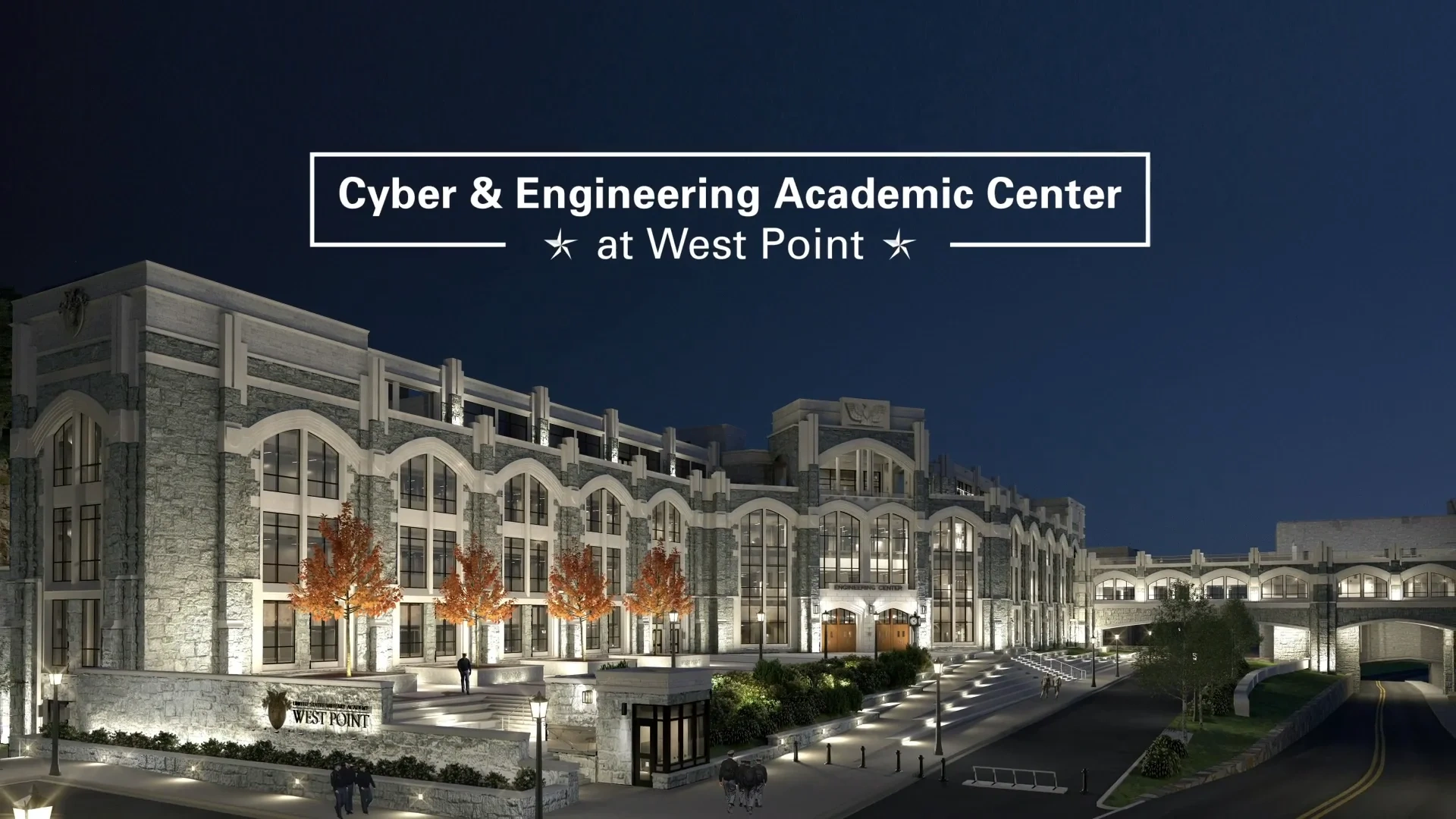
The Cyber & Engineering Academic Center (CEAC) at West Point is a ~145,000-sq-ft, four-story facility designed for STEM education, opened Q1 2026 academic year. The $400M project, situated south of the Central Area, features a structural steel frame with granite and limestone cladding to match historic Gothic architecture, connecting to Mahan Hall via a new bridge.
Structural steel frame with concrete masonry unit (CMU) backup walls and an air/vapor barrier.
Features a “Gothic style” exterior including natural limestone veneer, granite veneer, structural precast arches, and aluminum curtain walls, complemented by Tudor arches and buttresses.
Construction required the removal of 300,000 cubic yards of granite, involving significant blasting to prepare the site, according to a report from the AFBA
Includes a four-story structure, a multi-story underground parking garage, and a “Gateway” bridge connecting the facility to Mahan Hall.
Features high-bay areas with overhead lifts for robotics and drones, laboratory spaces, and a three-story, light-filled atrium with glass walls, notes the U.S. Army Corps of Engineers.
The Cyber and Engineering Academic Center (CEAC) at West Point is a modern academic facility that will enable and inspire collaboration across engineering disciplines. The CEAC will house the engineering laboratory functions of the Departments of Civil & Mechanical Engineering, Electrical Engineering & Computer Science, and Systems Engineering together under one roof. This 136,000-square-foot state-of-the-art facility will facilitate a powerful and broad impact within science, technology, engineering, and mathematics (STEM) scholarship and industry.
The CEAC will:
The CEAC’s award-winning design will provide wide-open, state-of-the-art spaces for project-based learning and designing/building solutions to real problems, resulting in a modern learning environment that encourages collaboration across the artificial boundaries created by organizational structures and physical spaces. This will allow the Academy to achieve a modern, adaptable, and inspirational level of engineering education that simply cannot be achieved in the current 1960s-style academic buildings/classroom spaces.